What the EPBD Means for Industrial Building Owners in Germany, the Netherlands, and Scandinavia
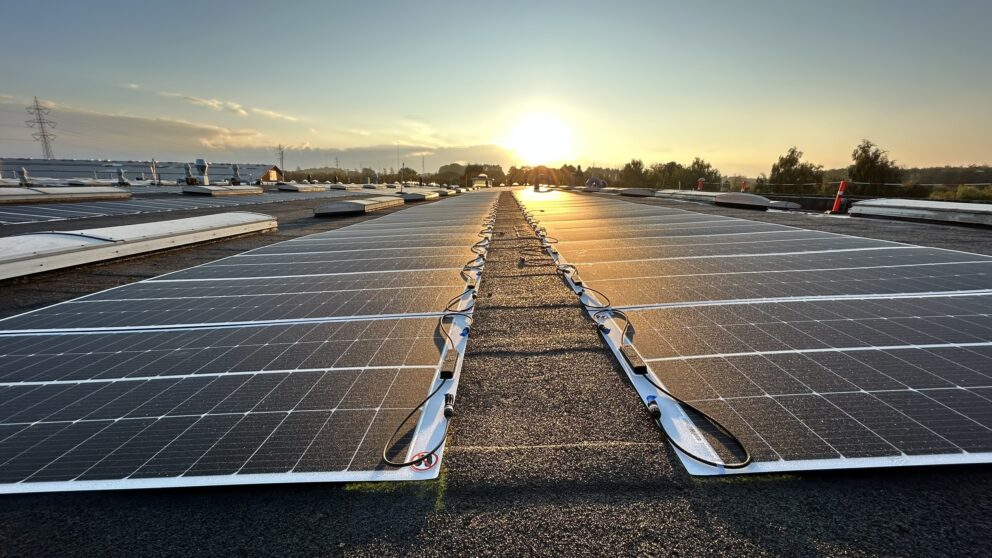
The EU’s ambitious European Green Deal aims to reduce the bloc’s GHG emissions by 55% by 2030. In line with this objective, new measures are being implemented to modernise building infrastructure and make net-zero buildings the standard. The ultimate objective is to make all buildings zero-emission by 2030.
If you’re unsure about what the implications of the Energy Performance of Buildings Directive (EPBD) are for your industrial or logistics portfolio, read on, as this article will cover what the directive requires, how Germany, the Netherlands, Denmark, and Sweden are approaching transposition, and what building owners with large flat-roofed commercial and industrial properties need to do.
For most industrial building owners across Northern Europe, the EPBD has until recently felt like something that belongs to architects, policy consultants, and developers of new residential stock.
This article sets out what the directive requires. We’ll also discuss how Germany, the Netherlands, Denmark, and Sweden are approaching transposition, and what it means in practice for building owners with large flat-roofed industrial and logistics properties.
What the EPBD requires of non-residential buildings
From 31 December 2026, all new public and non-residential buildings above 250 m² must be equipped with solar installations, with requirements for existing buildings of the same type phased in progressively from the end of 2027.
The obligation also extends to existing public and non-residential buildings from 31 December 2027 onwards, staggered by building type and size. All of these requirements are subject to the requirements being technically, economically, and functionally feasible.
Applying penalties for non-compliance is the responsibility of individual member states and could include fines, restrictions on building permits, suspension of building licenses, and other corrective measures. Of course, the consequences of not complying with the EPBD can be quite serious for building owners, which makes it important to understand what the rules entail.
The directive includes a feasibility clause that allows buildings to apply for an exemption from the solar installation requirement where installation is not technically, economically, or functionally viable. Structural load constraints are one of the grounds on which this exemption can be claimed. Whether pursuing an exemption is the right call is a different question. It does not remove the building from the broader energy performance obligations the directive introduces, and a documented exemption will increasingly feature in due diligence processes for lenders, investors, and buyers.
The solar mandate sits alongside a separate set of requirements for existing building performance. Member States must establish Minimum Energy Performance Standards targeting the worst-performing non-residential buildings, with renovation obligations covering the bottom 16% of the stock by 2030 and the bottom 26% by 2033. From 2030, all new buildings must meet zero-emission standards. For owners of large logistics and industrial portfolios, the cumulative effect is that building energy performance is moving from a background compliance matter into something that affects financing terms, asset valuation, and tenant conversations.
Germany: transposition in progress, new law expected by late 2026
Germany is transposing the EPBD through a new piece of legislation called the Gebäudemodernisierungsgesetz, or GModG, which will replace the current Gebäudeenergiegesetz. The federal cabinet was scheduled to adopt the GModG in May 2026, with passage through the Bundestag expected by late July or early August 2026. Germany has requested a formal extension from the European Commission, and until the GModG enters into force, the current GEG 2024 remains in effect.
The GModG introduces the harmonised A to G energy efficiency scale aligned with the EU framework, where Class A represents a zero-emission building and Class G represents the worst-performing 15% of the national stock. Renovation passports, digital building logbooks, and updated energy certificate requirements are also part of the package.
For owners of industrial and logistics buildings in Germany, the practical pressure is twofold. Buildings in the lower energy performance categories will face growing scrutiny from lenders and buyers as the new classification system takes effect. At the same time, the solar installation obligation for new non-residential buildings comes into force at the end of 2026, meaning that any new development or major refurbishment planned for 2027 or beyond needs to account for solar installation as a baseline requirement.
Germany also has a separate solar push through its Solarpaket 1, which is designed to reduce administrative barriers to solar deployment across commercial and industrial buildings. The combination of EPBD transposition and Solarpaket 1 creates one of the more demanding regulatory environments for commercial building energy performance in Northern Europe.
The Netherlands: phased transposition, solar provisions in the first tranche
The Netherlands is transposing the EPBD in tranches. The first tranche, scheduled for 29 May 2026, covers solar energy requirements, technical building systems, energy label adjustments, and installation inspections. The second tranche, planned for 1 January 2027, covers zero-emission building requirements and whole life-cycle carbon calculation obligations.
The Dutch government confirmed in early 2026 that provisions on Zero-Emission Buildings, renovation passports, and Energy Performance Certificate requirements are being drafted, and political uncertainty around the pace of transposition has been noted by property law specialists. The phased approach is intended to allow time for methodological development on the more complex provisions while still meeting the core May 2026 deadline on solar and technical systems.
The Dutch market features a significant concentration of large flat-roofed distribution and warehousing facilities, particularly around Rotterdam, Amsterdam, and Eindhoven. For industrial and logistics building owners in the Netherlands, the solar obligation is the most immediately relevant provision. Buildings with useful floor areas above 250 m² that are new or undergoing major refurbishment from the end of 2026 will need to address solar installation as part of the project scope.
The Dutch property sector is already relatively sophisticated on building energy performance, with energy labels playing an active role in lease negotiations and financing. The EPBD transposition accelerates existing pressure, but the formal solar mandate moves what was previously a voluntary measure into compliance territory.
Denmark and Sweden: EU members subject to the same transposition deadline
Denmark and Sweden are both EU Member States and are bound by the 29 May 2026 transposition deadline.
Denmark is among the more progressive European countries on whole life-cycle carbon for buildings, having already lowered its thresholds again in 2025 with typology-specific caps, and the EPBD aligns with the direction of travel in Danish building regulation. Sweden similarly has an established framework for building energy performance that the EPBD will build on.
Norway is not an EU member and is not directly bound by the EPBD transposition deadline, though as an EEA member it typically adopts EU directives with a short lag. Building owners with Norwegian assets should monitor transposition progress but are not subject to the same May 2026 deadline.
For Danish and Swedish industrial and logistics building owners, the key dates are the same as elsewhere: solar installations on new non-residential buildings above 250 m² from 31 December 2026, with existing building requirements phased in from 31 December 2027.
The structural load problem the EPBD does not solve
The solar installation obligations introduced by the EPBD assume, by default, that the buildings in question can physically accommodate a solar installation. For a significant proportion of Northern Europe’s industrial and logistics building stock, that assumption does not hold.
A conventional photovoltaic installation imposes roughly 15 kg/m² of additional permanent load on the roof surface. Research from the Becquerel Institute estimates that structural load restrictions block conventional panels from approximately 85 GW of European rooftop potential. Many of the large flat-roofed warehouses and logistics facilities built across Germany, the Netherlands, and Scandinavia during the mid-twentieth century were not engineered to carry that kind of additional weight, and a structural assessment will confirm quickly whether a proposed installation is viable.
When the structural assessment finds that a roof cannot support conventional panels, the building owner faces a choice. They can either invest in structural reinforcement, apply for a feasibility exemption from the solar obligation, or find a panel technology that works within the existing structural constraints.
Structural reinforcement can add between €150,000 and €200,000 per MW to project costs, extend timelines by several months, and typically requires operational disruption during the works. The feasibility exemption provides regulatory relief but does not address the underlying energy performance obligation or the growing pressure from lenders and investors on building energy credentials.
Lightweight photovoltaic systems are panels engineered to fall below 5 kg/m² by replacing tempered glass with composite laminates and bonding directly to the waterproofing membrane. They address the structural constraint at the panel level. This means that a building which would fail a structural assessment for conventional solar can often accommodate a lightweight installation without reinforcement or operational disruption.
What this means for portfolio planning
The practical implication of the EPBD for owners and managers of industrial and logistics properties across Germany, the Netherlands, Denmark, and Sweden is that building energy performance is moving from a background compliance matter to an active operational and financial consideration on a defined timeline.
Beyond legislation, it’s important to note that research consistently demonstrates the European market rewards green real estate with a significant premium on the market. For instance, Italian residential properties with the highest EPC ratings command a much higher average price.
The solar obligation for new non-residential buildings takes effect at the end of 2026, while the phased requirements for existing buildings begin in 2027. Minimum energy performance standards for the worst-performing non-residential buildings will create renovation requirements through 2030 and 2033.
For technical directors and asset managers with responsibility for large rooftop portfolios, the two most important steps right now are establishing the documented admissible load of each relevant rooftop through a current structural engineer’s assessment, and understanding which buildings fall into the worst-performing energy categories under the incoming national classification systems.
Both of these answers will determine what options are available and how much time there is to act on them.