Solar Panels for Buildings with Low Load-Bearing Capacity
Technical directors at solar projects dread the moment they find out the roofs cannot support the weight of the panels.
This happens more often than the solar industry tends to acknowledge. A significant proportion of commercial and industrial rooftops across Europe cannot physically accommodate standard photovoltaic modules, and structural load limitations are among the most common reasons why. For building owners trying to reduce energy costs, meet sustainability commitments, or prepare for incoming regulatory obligations under the EPBD, this problem means the difference between a project that gets built and one that gets shelved.
Why conventional panels create a weight problem
To understand why so many rooftops fail the structural check, it helps to look at what a conventional solar installation weighs.
A standard panel is essentially three components. There is a tempered glass face, which accounts for roughly 8 kg/m² on its own, an aluminium frame, which adds another 1 kg/m², and solar cells (less than 0,6 kg/m²).
The mounting structure, steel rails and anchors that fix the panels to the roof typically add between 2 and 5 kg/m² more.
On a large industrial rooftop, these figures become significant quickly. A 5,000 m² warehouse roof carrying a full conventional installation could bear an additional 55 to 70 tonnes of permanent load, while buildings constructed for logistics or light manufacturing were rarely designed with this kind of additional weight in mind, particularly older stock where the original structural calculations are sometimes difficult to locate.
The mounting method compounds the issue because ballasted or mechanically anchored racking concentrates load at discrete fixing points rather than spreading it across the full membrane, which means certain areas of the roof bear considerably more than the average figure suggests.
What happens during a structural assessment
Before any solar project moves forward on a commercial or industrial building, a structural engineer needs to establish the documented admissible load of the rooftop.
This refers to the maximum additional permanent load the structure can safely carry, expressed in kg/m², and it is a crucial figure because everything else is calculated against it.
The process involves reviewing the original structural blueprints, assessing the condition of the roof truss or deck, and accounting for any modifications made since the building was constructed.
Where documentation is incomplete, which is common with older industrial buildings, a physical site inspection is required. Engineers measure structural components directly and assess their condition before any reliable load figure can be produced.
When the assessment confirms that the roof cannot support even the lightest conventional system available, the project can either proceed with structural reinforcement, replace the roof, or find a different kind of panel.
The reinforcement problem
Structural reinforcement is the route most installers default to, and for some buildings, it is the right answer even though the costs are substantial. Strengthening a commercial rooftop to accommodate conventional panels can add between €100,000 and €250,000 per MWp to the project, and that is before accounting for the time it takes. Most reinforcement programmes extend project timelines by several months, often requiring partial or complete suspension of operations in the affected areas of the building.
For a logistics facility or a manufacturing site, that kind of operational disruption carries its own costs that rarely appear in the initial project appraisal. A project that looks marginal on energy economics alone can become financially untenable once reinforcement, extended timelines, and lost operational productivity are factored in, which is why many promising installations never get past this point.
How lightweight solar technology changes the calculation
The arrival of commercially viable lightweight photovoltaic systems has opened a third path that was not available to most building owners a decade ago.
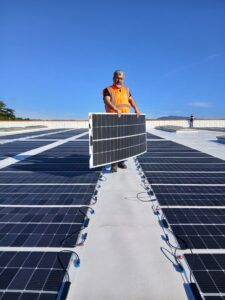
The weight reduction starts with the panel itself, by replacing the tempered glass and removing the frame, which brings the panel standard 11 kg/m² down to under 5 kg/m². This one change eliminates the heaviest component of a conventional system before anything else has been modified. From there, the mounting method changes too, and instead of steel racking bolted or ballasted onto the roof, lightweight panels are bonded directly to the waterproofing membrane using industrial adhesives. The mounting structure disappears entirely, and the panel weight is distributed evenly across the full surface rather than concentrated at fixing points.
The result is a complete system that can fall below 6 kg/m², well within the admissible load of rooftops that standard panels would immediately disqualify. The membrane stays intact throughout, and there are no penetrations, anchors, or modifications required to the existing waterproofing.
What surprises many building owners when they model the full project economics is that lightweight systems often produce a lower total cost than conventional installations and reinforcement, even when the panel cost per watt-peak is slightly higher. If you remove €350,000 in reinforcement costs and eliminate four months of delayed commissioning, the arithmetic shifts considerably.
The regulatory pressure is building behind this
The EPBD recast, which entered into force in May 2024 with a transposition deadline of May 2026 for Member States, introduces mandatory solar obligations on new non-residential buildings from 31 December 2026. Existing public and non-residential buildings follow on a staggered timeline from 2027 onwards, subject to the requirements being technically, economically, and functionally feasible.
The feasibility clause is important because documented structural unsuitability is one of the recognised grounds for exemption from the solar obligation. A building whose roof cannot support panels may not be required to install them. However, the exemption from the solar mandate does not exempt a building from the broader energy performance requirements the directive introduces, and in most cases it is not a position that building owners want to be in from an asset value or ESG reporting perspective.
The more pressing issue for most technical directors is simply the timeline. A structural assessment, any required engineering work, procurement, and installation take time.
Three questions worth asking before any project begins
Regardless of which technical route a project takes, there are three questions that should be answered before any tender is opened on a commercial or industrial rooftop.
The first is straightforward and involves asking yourself what the documented admissible load of your roof is.
The second concerns the installer’s experience. Has the company carried out projects on low-load-bearing rooftops before? Asking for specific references, including surface area, location, and completion date, is a reasonable and informative test of whether the answer is genuine.
The third is about project economics. Has the total cost been modelled with structural reinforcement included? A panel that appears cheaper per watt-peak at the component level can produce a significantly more expensive project once the full installation cost is on the table.
A concrete example
Consider a logistics warehouse with 20,000 m² of flat rooftop and a documented admissible load of 10 kg/m². A conventional installation on that roof requires structural reinforcement. At current European cost benchmarks, that reinforcement adds more than €200,000 to the project and pushes commissioning back by around four months.
On a project with a payback period measured in years, four months of delayed generation and €200,000 of additional upfront capital have a meaningful effect on the return.
A lightweight installation on the same roof proceeds without reinforcement.
The additional capital cost disappears, commissioning happens on schedule, and the building starts generating self-consumption energy roughly 120 days earlier. At current industrial electricity prices in Central Europe, the combined benefit of avoided reinforcement costs and earlier generation can represent a substantial difference in overall project economics.
What this means in practice
The structural load problem has historically been treated as a reason to abandon solar projects on certain building types. That framing is becoming less accurate as lightweight photovoltaic technology matures and achieves the certification standards that commercial insurers and building owners require.
For building owners with large portfolios of commercial or industrial property, understanding the load capacity of each rooftop is increasingly a prerequisite for meaningful energy strategy and shouldn’t be seen as a mere technical detail to resolve project by project.