Why So Many Commercial Solar Projects Stall at the Structural Assessment Stage
26/05/2026
There is a particular point in the lifecycle of a commercial solar project where everything tends to unravel. Issues like the roof not being able to support the weight of the panels is a common problem with many projects. What had looked like a straightforward infrastructure decision suddenly becomes a much more complicated conversation about reinforcement costs, timeline extensions, and whether the project still makes financial sense at all.
This moment plays out across European commercial and industrial properties far more often than the solar industry tends to acknowledge. According to research from the Becquerel Institute published in PV Magazine, structural load restrictions block conventional panels from an estimated 85 GW of rooftop potential across the continent. A TÜV Süd study in Germany found that only 25% of rooftops are fully suitable for photovoltaic systems without restrictions, with a significant share excluded specifically because of weight concerns. These figures point to a structural problem at the heart of Europe’s commercial solar ambitions, one that is not going away as rooftop solar obligations tighten under the EPBD recast.
The gap between ambition and available rooftop stock
Europe’s solar capacity has grown at a pace few would have predicted a decade ago. Annual installations tripled between 2020 and 2025, and the EU reached its 400 GW target ahead of schedule. The next challenge is unlocking the segments of the built environment where conventional technology cannot go.
Commercial and industrial rooftops represent the most significant untapped opportunity in this respect. Warehouses, logistics hubs, manufacturing facilities, and large retail properties offer vast flat surfaces that should, in theory, be well suited to solar generation. The complication is that a large proportion of this stock was built during the mid-twentieth century, when developers prioritised low-cost, large-span roofing structures that were engineered to meet the load standards of the time and nothing beyond. When these buildings were constructed, nobody was designing rooftops to carry photovoltaic systems, and the structural margins left for future loading were in many cases minimal. Decades later, many of these buildings remain in active commercial use, with the same structural constraints intact and no straightforward path to accommodating a conventional solar installation.
What a structural assessment involves
Before any solar project proceeds on an existing commercial or industrial building, a qualified structural engineer needs to establish the admissible load of the rooftop. This is the maximum additional permanent load the structure can safely carry, expressed in kg/m². This figure then gets compared against the weight of the proposed installation to determine whether the project is structurally viable as designed.
Most building owners underestimate how heavy a conventional photovoltaic system is. The tempered glass face of a standard panel accounts for roughly 8 kg/m² on its own, before anything else is added. An aluminium frame contributes another 1 kg/m², and the steel mounting rails and anchors that fix the panels to the roof surface typically add a further 2 to 5 kg/m². Taken together, a conventional rooftop installation imposes roughly 15 kg/m² of additional permanent load on the structure beneath it. On a 5,000 m² industrial rooftop, that means somewhere between 55 and 70 tonnes of additional weight on a building that was never designed to carry it.
The assessment process involves reviewing the original structural blueprints, evaluating the current condition of the roof deck and truss, and accounting for any modifications that have been made to the building since it was first constructed. For older industrial stock, original documentation is frequently incomplete or difficult to locate, which means on-site measurement becomes necessary before any reliable load figure can be established. When the assessment finds that the roof cannot accommodate the proposed system, the project enters a decision point that rarely appeared in the original financial model.
Why reinforcement is not always the answer it appears to be
The instinctive response to a failed structural assessment is to reinforce the roof and strengthen the structure sufficiently to support the planned installation and proceed as originally intended. Sometimes this is the right course of action. More often, the costs and timelines involved are considerably larger than they appear at first, and they have a way of transforming the economics of a project that initially looked straightforward.
Structural reinforcement on a commercial rooftop typically adds between €100,000 and €250,000 per MWp to project costs. In addition to the capital outlay, most reinforcement programmes require partial or complete suspension of operations in the affected areas of the building for a significant period, and they extend the overall project timeline by several months before a single panel can be installed. For a logistics facility, a distribution centre, or a manufacturing site running on tight operational schedules, that disruption carries its own costs that rarely appear in the initial project appraisal.
When all of these factors are properly accounted for, including the reinforcement capital, the extended timeline, the operational disruption, a project that looked financially viable on energy economics alone frequently becomes difficult to justify. Many commercial solar projects that stall at the structural assessment stage never recover momentum from this point.
The installer moves to other work, the building owner defers the decision indefinitely, and the rooftop remains unused.
The regulatory context that makes timing critical
The EPBD recast, which entered into force in May 2024 with a transposition deadline of May 2026, introduces mandatory solar installation obligations on new non-residential buildings from 31 December 2026, with existing public and non-residential buildings following on a phased timeline from 2027, subject to feasibility conditions.
A building with documented structural constraints may qualify for an exemption from the mandatory solar installation requirement under the feasibility clause. What the exemption does not remove is exposure to the broader energy performance requirements the directive introduces, and from an asset value and ESG reporting perspective, relying on a structural exemption is a position that most building owners and asset managers would prefer to avoid. The more pressing issue for most technical directors is simply the timeline: a structural assessment, any required engineering work, procurement, and installation take time, and the organisations that start the process early have considerably more flexibility than those who leave it until compliance deadlines are approaching.
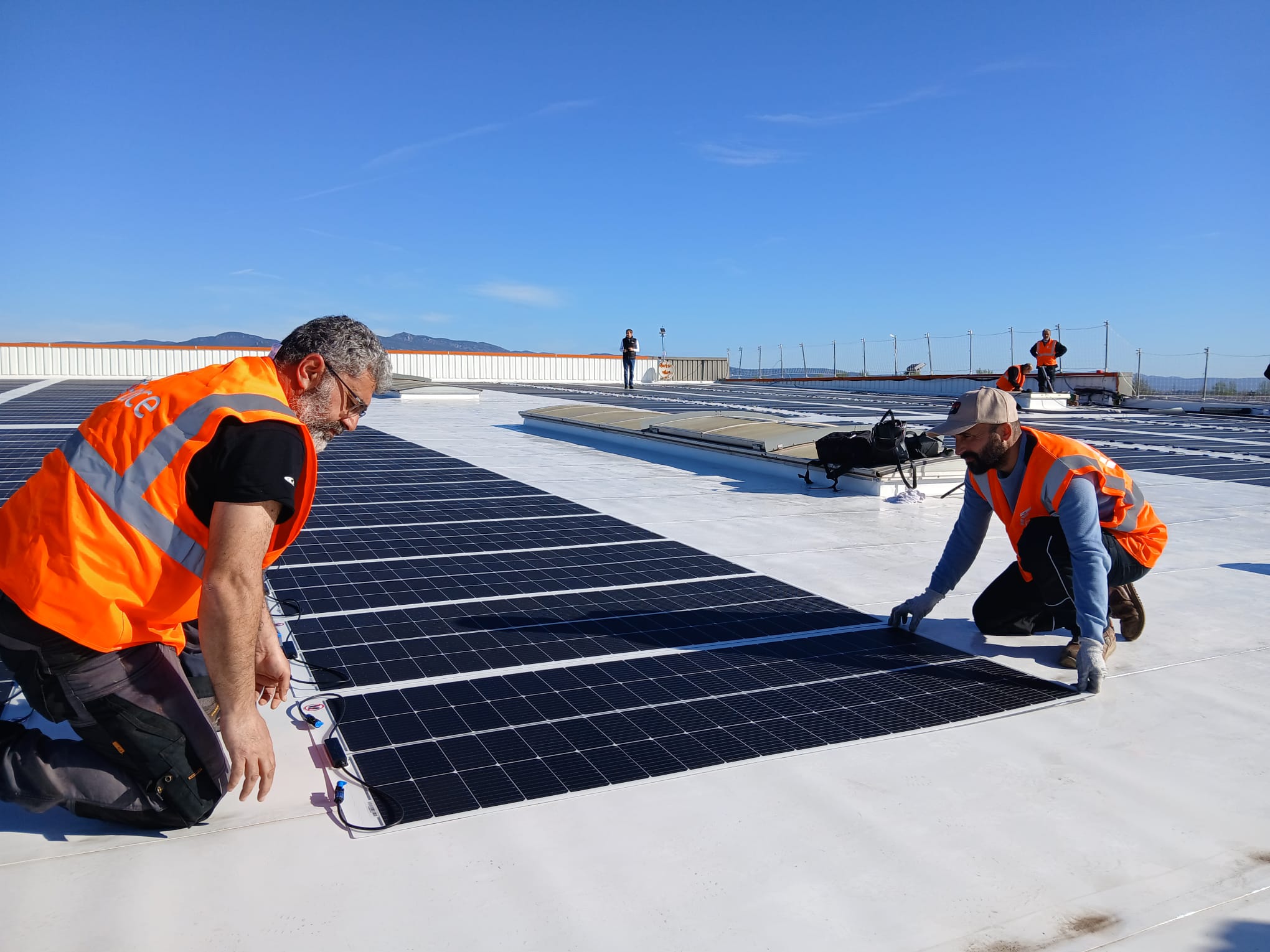
How lightweight photovoltaic technology changes what is possible
The weight problem inherent in conventional solar systems is a consequence of specific material choices, principally tempered glass, which accounts for the majority of a standard panel’s weight.
Lightweight photovoltaic systems address this issue at the panel level, rather than accepting the load burden of conventional materials and then compensating for it through structural reinforcement.
Replacing the front glass and removing the frame reduce the panel’s weight from around 11 kg/m² to 5 kg/m², eliminating the heaviest components of a conventional system before anything else changes. Bonding the panels directly to the waterproofing membrane using industrial adhesives removes the steel mounting structure entirely and distributes the remaining panel weight evenly across the full roof surface rather than concentrating it at fixing points.
The combined result is a system that can fall below 6 kg/m², well within the admissible load of rooftops that standard panels would immediately disqualify, and one that requires no roof penetration and leaves the waterproofing membrane intact throughout installation. The economics of this approach are frequently mischaracterised as being driven by higher panel costs.
Lightweight panels do carry a slightly higher cost per watt-peak at the component level than conventional glass modules, but when reinforcement costs, extended timelines, and operational disruption are removed from the project entirely, the total installed cost frequently favours the lightweight route.
Three questions worth raising before the structural assessment
The structural assessment stage catches commercial solar projects off guard partly because the question of roof load capacity is rarely raised at the start of the process. By the time the engineer’s report reveals a problem, the project has already invested significant time and money in design work, energy modelling, and installer evaluation, and the options available have narrowed considerably.
Before any of that work begins, three questions deserve answers.
First, what is the documented admissible load of this rooftop as assessed by a qualified structural engineer today, not a figure recalled from the original construction documentation or estimated by the building developer? Structural conditions change over the decades, and a current assessment by a qualified professional is the only reliable starting point.
Second, has the total project cost been modelled with structural reinforcement included as a contingency? The relevant financial comparison for any commercial solar decision is total installed cost, and a panel that appears competitive on a per-watt basis can produce a significantly more expensive project once structural work enters the equation.
Third, does the installer have verifiable experience with low load bearing rooftops? Asking for specific project references, including surface area, building type, and completion date, is a straightforward way to establish credibility.
The scale of the opportunity
Europe’s 2030 solar targets require a substantial expansion of commercial and industrial rooftop capacity, and the Becquerel Institute’s estimate of 85 GW currently blocked by structural constraints puts the scale of the untapped opportunity in clear terms.
Addressing that gap through reinforcement alone is neither economically viable nor practically achievable at the speed required. Lightweight photovoltaic technology has reached the point where it meets the certification standards required by commercial insurers, building owners, and EPC contractors, and it is opening up a segment of the European rooftop stock that conventional panels cannot reach. For the buildings that make up a significant proportion of the continent’s logistics, manufacturing, and retail infrastructure, the structural assessment stage is no longer necessarily the point at which a solar project ends.
Heliup develops and manufactures lightweight photovoltaic panels for commercial and industrial rooftops with structural load constraints. Stykon® panels weight under 5 kg/m², require no structural reinforcement, and are installed without roof penetration.